

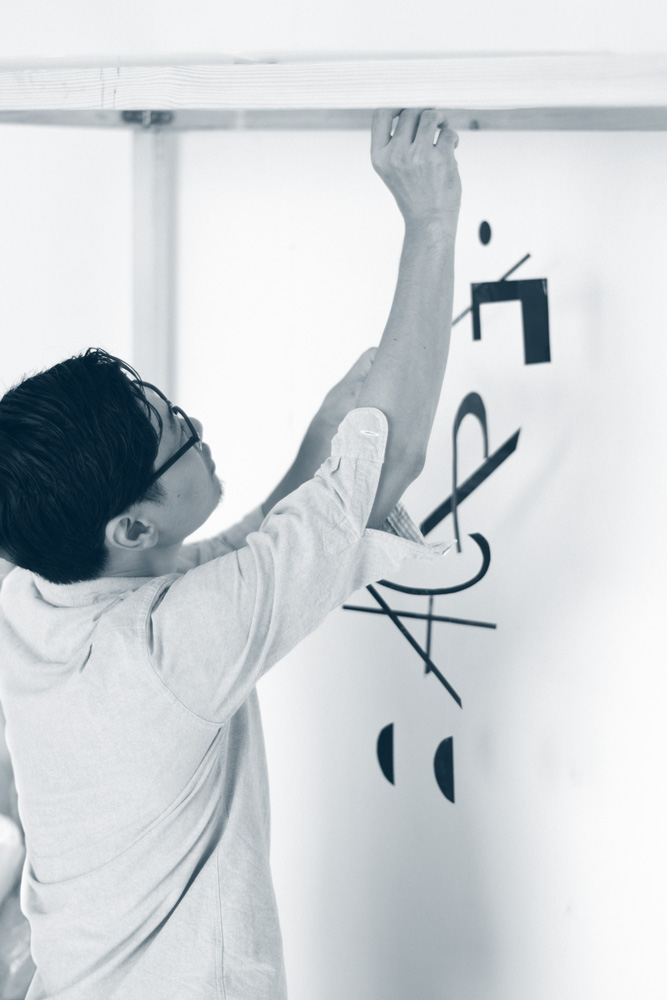

Daijiro OHARA
A designer based in Tokyo, focuses on typography, graphics, sculptures and editorial projects.
–
Searching for Methods Text: Kiyonori Muroga 〈IDEA magazine〉
Current design
The modern design is developed within
rules of linear technique and economy.
The reform of technology challenged
those rules, but the reality has been
always ruled by the market
fundamentalism. In the
post-industrialization era, designers
becomes more and more an abstract
existence in the linear structure.
How
can modern graphic designers be
recognized under their own name.
Independent publications and projects by
graphic designers have become popular in
the 2000s mainly in Europe and the US.
Through those movement graphic designers
seemed to have tried to relate
themselves with society through their
productions in the rapidly developing
world economy and the technocracy.
Japanese
graphic designers under such an
influence those days, and including zine
booms, regarded that trend as the
fashion of craft, “manufacturing”.
Japanese designers have gradually forgot
to consider the heterogeneity of
“design” of the Western origin after
rapid economic growth. Particularly in
latest years genericization and
commoditization of design methods
developed, and people haven’t discussed
whether it was appropriate or not, after
all they accepted design as it was, and
it became a discipline.
Here is one
paradox. For Japanese designers to ask
themselves “what is design?” became a
driving force of critical thinkings and
practices while a measure, “modern
design” have brought from the outside of
Japan. In other words, it may be said
that the whole ways of thinking of
designers including misunderstandings
and perversions brought constant
strength in Japanese graphic designs
after the world war II. Designers lost
dynamics of thought in global
informational environment, and the
question “what is design?” lapsed into
business catch phrases now.
Toward the origins of “hand writing”
It was the mid-2000s, the dying of those
graphic designs became an everyday
affairs when works of Ohara Daijiro
gathered attention. It was design work
for music industry with full use of pop
hand writings to make him spring into
fame. He integrated illustration and
texture in modern style adding tastes of
commercial lettering after the WWII.
While interests for typography, letter,
and tastes of craft increased, his
styles became popular and produced many
followers.
However, those lettering
of hand writing is not the point for
him, as those were just outcomes of each
project’s request and process. He never
clang to hand writing, made full of
various materials, such as illustration,
objects, and photograph as he liked
after the period.
The answer what
was he interested in gradually became
clear through a display project and a
workshop held vigorously parallel to
client work in the after 2010s.
The
main theme of these display and
workshops was a relationship between a
subject and the world through physical
actions like “to write” or “to
speak”.
Ohara began to think over
it, after he knew that Ishikawa Kyuyo, a
famous calligrapher, explained a
relationship between human body and the
act of creating, such as “to speak” “to
write” in his book,”structure of a touch
of a brush.
According to Ishikawa,
“to speak” is “an expressing act of a
human being through mobilizing all the
functions of physical parts to release
consciousness to the air” and utterance,
gesture, and performing arts such as
singing belong to it. On the other hand,
“to write” is “an expressing act through
working on objects such as nature with a
tool and transforming them reducedly”
and letter, drawings, sculptures, and
books belong to it.
He was inspired
the idea free from the suppression of
the institutional division such as
“illustration”, “design” or “art” and he
began to explore the heart of production
through “writing” and “speaking”.
Method and power
Ohara went back to the point where
design originally occurred from the
given environment divided by the modern
concept of “design” and try to
comprehend so called “design” field by
reconsidering physical actions. Such an
application of an anthropological
viewpoint may have been overlooked in
the Japanese modern design development.
“Graphic” comes from a Latin word
“gráficos”, so as Ohara has been doing,
“to re-comprehend graphic design from
the viewpoint of “how to write” is
literally appropriate in comprehending
set of issues of “graphic”.
However,
in Japan for many years as “graphic” has
been accepted only in an industrial
aspect or the trend of the times, mainly
printing, we never stop regarding
graphic design as concrete object like
“poster design”.
It may be the evil
of prioritizing technology introduction
to catch up with Europe and the US
rapidly or we may have come to realize
what the problem was simply because now
is the time of the
post-industrialization Era.
It is
important to know that Ohara’s display
and workshop are not privileged as are
important to an ex-graphic designer not
being a thing made a special privilege
as “self-expression” as graphic
designers once pretend to be an artist
contrary to “the client work”.
As
the outcome of the Ohara’s independent
project develop in work in the
commercial world, commercial environment
is a test cite, and also become a start
point for the next project.
As well
as the cross reference of each project,
Ohara also promotes conversion and
diversion of methodology and the concept
cultivated in other domains such as
music. If we pursue “writing”, we are
prone to be constrained by the field of
pure expression, the way to avoid that
and to remain using design as
communication is to be conscious of
application of methodology of the other
field.
Ohara is not only the
specialist of handling “letter” as
mentioned above, however, his
methodology mainly depend on
“typography”. It is the typography as
musical notation, composing and
arranging sets of elements under a
certain law, or methodology of
recognizing and constructing the world,
not the typography as formative art. In
that sense Ohara can be called “the
person of the method”. In “TypogRAPy, a
project with Hasunuma Shuta and llreme,
composing musical pieces by going
between audible figures and a visible
sound images led by a writing act,
Ohara’s methodology is going to be
raised in comprehensive art at last.
Practice and thought
The word “workflow” and “direction”
implies senses of rationality and
linearity. Ohara’s way seems to be too
complex and wind for this conventional
view of the world. How successful have
Ohara Daijiro’s series of attempts been?
I have no privileges to judge that, but
I find something important through
apparently pop practices because his
complicated methodology has strong
persuasive power.
Now that the
dusputed issue of the emblem for the
2020 Tokyo Summer Olympics revealed the
gap between an institutional frame of
graphic design and real information of
today, essential questions such as “what
is design?”, or”What should design be?”
are reappearing after missing
decades.
The word “design” is
installed in our way of thinking or
behavior a circulation circuit and we do
not seem to be able to discuss ”design”
without using the word “design”, but if
we discuss it in that way, after all the
discussion is intrinsically barren.
There
ought to be methodological turn as
Ohara’s attempt to redivide graphic
design from the perspective of
anthropology or as his repel suppression
of the linear communication of the
typography by taking over and converting
the methodology of typography.
I’d
like to watch carefully Ohara’s
practical thought and practices through
thought process which he has already
piled up and is probably continuing from
now on.
- –
- Daijiro Ohara was born in Kanagawa Prefecture in 1978. He graduated from
- Musashino Art University in Tokyo, and started working independently in 2003. He
- is principal of Omomma, a studio focused on lettering, illustration, motion graphics
- and art direction. Beside commissioned work for music videos, commercials,
- packaging and publications, he has also been actively engaged in self-initiated
- projects, searching for new perceptions of words and letters through exhibitions,
- workshops and fieldwork. His installation “Typogravity” is an attempt to find the
- ur-form of letters in landscapes while his project “Riding on Characters” shows how
- the lettering on a skateboard may be altered by physical and environmental factors.
- His graphic series “Ridge Line” is the reconstructed mountain photography and
- trekking map and “TypogRAPy” is his performance with musician Shuta Hasunuma
- and rapper Illreme. His project “Hello Fukei” is a collection of haiku poetry,
- expressed via mobiles and illustrations. Ohara was the recipient of the 2014
- JAGDA New Designer Award and the 2014 Tokyo TDC Award.
–
大原大次郎
1978年神奈川県生まれ。2003年武蔵野美術大学基礎デザイン学科卒業。タイポグ ラフィを基軸とし,グラフィックデザイン、出版、CI計画、宣伝美術、パッケージデザイン等に従事するほか、展覧会、ワークショップ、パフォーマンスを通 して、言葉や文字の新たな知覚を探るデザインプロジェクトを積極的に展開する。
近年のプロジェクトには、重力を主題としたモビー ルのタイポグラフィシリーズ〈もじゅうりょく〉、山岳写真と登山図を再構築したグラフィック連作〈稜線〉、スケートボードに彫られた文字を身体的アプロー チや環境要因によって変化させていく彫刻〈文字に乗る〉、音楽家と共に展開する発声と書字のパフォーマンス〈TypogRAPy〉などがある。共著に俳句集『ハロー風景』。
2014年JAGDA新人賞、東京TDC賞受賞。

 http://omomma.in/